
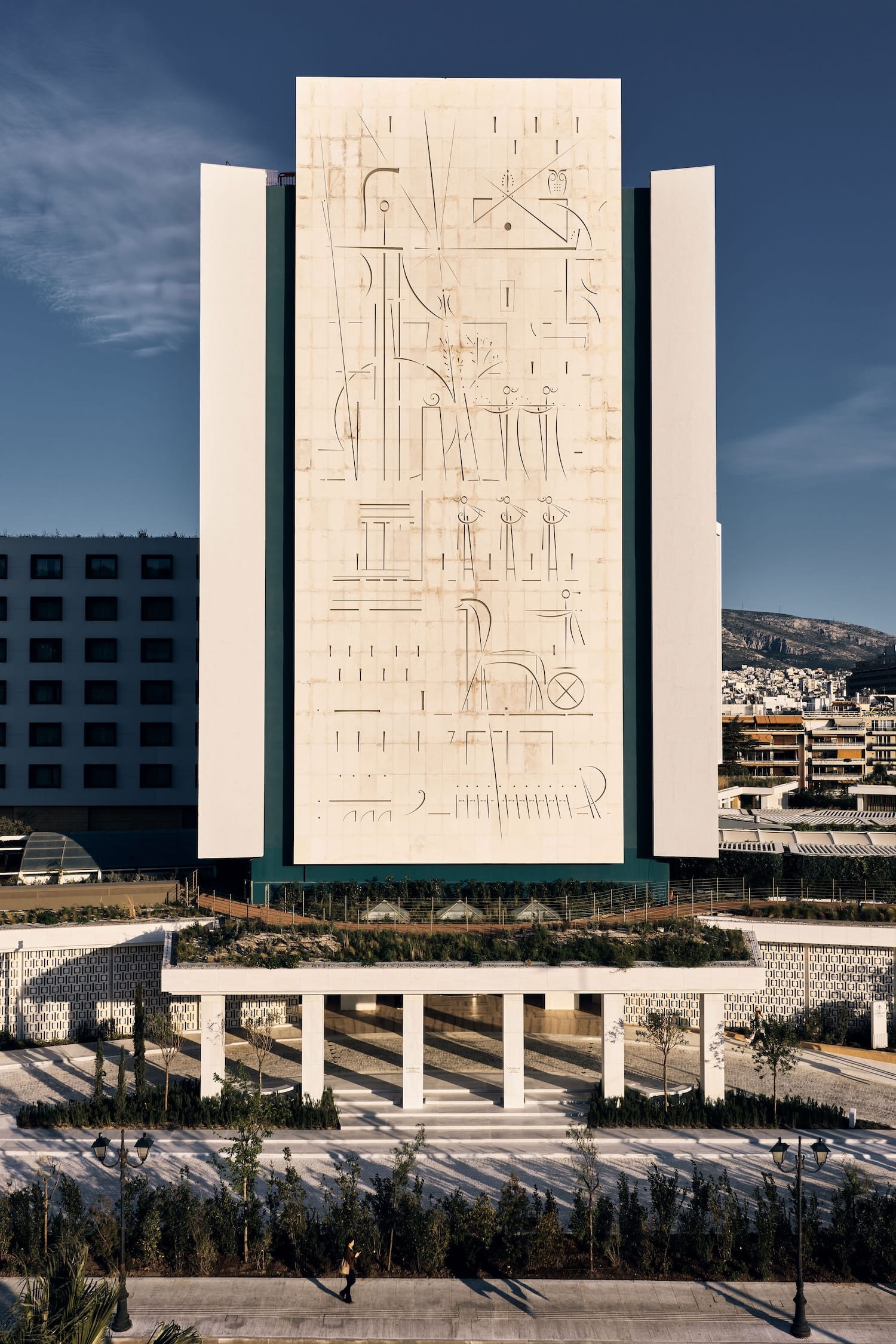
There are hotels that belong to a brand, and there are hotels that belong to a city. The building Athenians still simply call ‘the Hilton’ has always been the latter. When it opened on the Greek capital’s Vasilissis Sofias Avenue in April 1963, designed by Emmanuel Vourekas, Prokopis Vassiliadis, Antonis Georgiadis and Spyros Staikos, it was less a hotel than a declaration: post-war Greece stepping onto the world stage, shipping fortunes in full swing, the jet set descending. Sinatra drank at the rooftop Galaxy Bar. Conrad Hilton called it the most beautiful Hilton in the world. Yannis Moralis carved 620 square metres of Pentelic marble reliefs across its facade, an open-air artwork so recognisable that the surrounding neighbourhood, and even the bus stop, took the hotel’s name.
Now, exactly 63 years to the day after that first opening, it has returned as Conrad Athens The Ilisian, the brand’s Greek debut. And here is the surprising part: it doesn’t feel like a Conrad at all. It feels like The Ilisian, a hotel entirely of its own making, and one of the most confident design statements Athens has produced in decades.


The restoration
The transformation, led by Athens practice Aeter Architects with interiors by New York studio AvroKO and art curation by MARE Studio, halves the room count from 507 to 278 and treats the building’s history as material rather than nostalgia. The lobby sets the tone: a long water feature traces the line of the Ilissos river, which once flowed where the hotel now stands. Vintage Saridis furniture from the original interiors sits beside new commissions from the same Athenian workshop. The back wall carries the “Athens by Night” ceramic mural, executed by Eleni Vernadaki after a Moralis design, and one of the original 1963 chandeliers hangs once more above the circular bar of the sunken Athenian Lounge. Moralis is everywhere if you look: the horse-form lamps on Studio Niko Koronis’ stacked-stone reception desk, sculptural door handles in the memorabilia display, a plaster replica of the facade relief that lets you study up close what the city has admired from the street for six decades. It is super tasteful, and it is done with restraint – a nod to the golden age rather than a costume of it.


The setting
The address remains one of the best in Athens: the junction of Kolonaki, Pagrati and Ilisia, minutes from the Benaki, the Byzantine and Christian Museum and the National Gallery next door, with the Acropolis two miles down the avenue. What is genuinely rare, though, is what sits behind the building. The Oasis is the largest outdoor pool in the city, deep enough for proper lengths, with a diving board, canary-yellow parasols and a crowd that gives the whole scene a Slim Aarons quality – all elegance and sun-warmed marble, sixty years compressed into an afternoon.
The buzz is structural, not accidental. The pool, gym and wellness floors are shared with House of Nynn, the members’ club created by Temes, the developer behind Costa Navarino, and Athens’ first of its kind. The result is a hotel that hums with locals: Athenians swimming between meetings, lunching by the pool, filling the restaurants at night. As a guest, the wellness offering surpasses anything a city hotel would normally attempt: a performance gym, Pilates, yoga and Gyrotonic studios, a cycling darkroom, heat and cold therapy, and a planted 770-metre running track wrapping the green roof with panoramic views of the city.

The club
The buzz is structural, not accidental. The pool, gym and wellness floors are shared with House of Nynn, the members’ club that opened in summer 2025 as The Ilisian’s first chapter – created by NYNN, the lifestyle brand founded by Temes, the developer behind Costa Navarino, and the first modern club of its kind in Athens. It spans some 5,500 square metres indoors across three levels: an all-day Living Room, a co-working Forum with a library, podcast studio and even a napping room, and a wellness floor below with a performance gym, Pilates, yoga and Gyrotonic studios, a cycling darkroom and heat and cold therapy. For a city that never had a club on this scale, it has become a genuine piece of local infrastructure – and it fills the hotel with Athenians. Guests mix with chic locals at every turn: swimming between meetings, lunching under the parasols, filling the restaurants at night.
For hotel guests, the Oasis is where the generosity shows. Every lounger comes with a complimentary Fieldbar cooler stocked with water, and treats circulate through the afternoon – the hallmarks of a properly run five-star resort, transplanted to the centre of a capital. Add the planted 770-metre running track wrapping the green roof, with panoramic views of the city as you make your way round, and the wellness offering surpasses anything a city hotel would normally attempt.


The rooms
The bones are those of a 1960s business hotel, and the rooms don’t entirely disguise it. But they are impeccably resolved: spacious, quiet, mid-century in register, with marble, warm wood and brushed brass against slate grey and cream. Some look to the Acropolis, others over the pool or the Athenian skyline. The detail is where they win you over – Byredo in the bathrooms, Korres amenities connecting you to Greece, beach bags, yoga mats, an iron, an exceptional shower. Everything you need, nothing performative.
The dining
Breakfast is where the hotel most decisively sheds its flag. Conrad could have defaulted to a buffet and a coffee cart; instead, breakfast at Byzantino Grande Brasserie, designed by Paris-based Tristan Auer, is one of the best we have had in any hotel, city or otherwise. The room is vast but reads as three: an elegant colonnaded interior beneath the domed centre, a café courtyard, and a garden arranged into corners so intimate you could believe you were in a 20-room property. The à la carte alone is complete – Greek breakfasts of feta and scrambled eggs, omelettes, granola bowls, artisan Greek teas – and the coffee is taken as seriously as it should be in Greece: Greek coffee, proper espresso, freshly fried dough. The buffet adds Greek cakes, cold cuts and yoghurt, and the staff will go to the kitchen for anything not on it. Dinner is under executive chef Angelos Lantos, the first Greek chef to hold two Michelin stars in Athens, with a menu split between French and Greek and a cheese room with its own sommelier.
Lunch by the pool at the Italian restaurant is the other register entirely: thin, crisp Roman pizza, spritzes, iced coffee and a chic Athenian crowd. Still to come: the return of the fabled Galaxy on the rooftop as the Galaxy Dispensary and Galaxy Supper Club, and a Peruvian restaurant alongside.


Not to miss
AvroKO’s lobby flows into a 325-square-metre concept store curated by Anthologist – Greek artisan crockery, bags, shoes and clothing – alongside Greece’s first Monocle Shop, with pop-ups from Greek luxury house Zeus+Dione by the pool. A grotto-like florist completes the picture, its candles and arrangements worth a detour of their own. The original Hilton told the world that Athens had arrived. The Ilisian makes a quieter, more assured claim: that it never left.

Dubai-based Isabella Craddock is the founder of Near+Far, a founding Academy Chair for The World’s 50 Best Hotels, former Condé Nast Traveller editor and a hotel-obsessed, design-devoted travel planner—for friends, loved ones, and readers alike.



discuss
Email
Pin
Tweet
Share