

For centuries, the Red Sea was known only to fishermen, divers, and those who lived along its untouched coastlines. Now, it is being transformed into one of the most ambitious travel destinations the world has ever seen – a constellation of luxury resorts, wellness sanctuaries, and desert icons designed to open up a region that until recently was little more than myth to travellers.
This is not a destination that has evolved over decades of gradual tourism. It is one that has been imagined, meticulously planned, and now brought to life in a way that fuses futuristic architecture with extraordinary natural landscapes. To visit today is to witness a destination in its opening chapter, and to be part of a story that is only just beginning.

The Red Sea’s islands
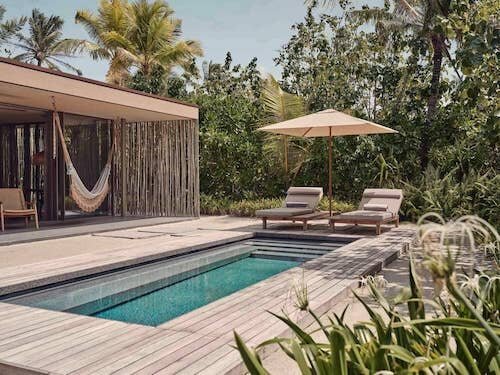
The Red Sea’s greatest treasures are its islands: unspoiled, dazzlingly white-sand outcrops scattered across a turquoise seascape. Among them is Ummahat Island, home to the St. Regis Red Sea Resort, which opened in early 2024. This was the very first resort to welcome guests, and it set the tone for everything that followed: overwater villas and private pools that hover above coral reefs, a design aesthetic that is both minimalist and dramatic, and St. Regis’s signature butler service delivered in barefoot style.
Not far away, Nujuma, a Ritz-Carlton Reserve, also opened in 2024, introducing travellers to one of Marriott’s most exclusive brands. With just 63 villas, each with its own private pool, Nujuma has already been hailed as one of the most desirable new hotels in the world, a place of total seclusion and service so intuitive it feels almost telepathic. Here, the Red Sea’s untouched reefs are literally at your doorstep – a marine wonderland to rival the Maldives, but without the crowds.
And then came Shebara. Opened in late 2024 on Sheybarah Island, this futuristic resort is unlike anything else in the region. Its villas are reflective steel orbs, suspended above water or nestled into the sand, designed by Dubai’s Killa Design and conceived as an architectural icon. By day, they shimmer like mirages against the sea; by night, they reflect the stars in all their clarity. Inside, interiors by Studio Paolo Ferrari embrace curved dimensions and futuristic textures, creating a sense of stepping into another world.
And the momentum is only building. Four Seasons, Grand Hyatt, and other luxury names are preparing to open their own island resorts in the coming years, promising a Riviera-style buzz.

The Red Sea’s desert
The Red Sea experience doesn’t stop at the water’s edge. Inland, desert landscapes of rock and sand form the backdrop for some of the region’s most dramatic hotels. Six Senses Southern Dunes, The Red Sea, designed by Foster + Partners, was the very first hotel to open in the development, in late 2023. Here, the brand’s signature sustainability and wellness ethos takes on a Bedouin soul. Guests stay in villas that curve into the dunes, wake to silent desert sunrises, and spend evenings under skies so thick with stars they look painted on.
In December 2024, Desert Rock opened – an architectural marvel carved directly into a granite mountainside. Designed by Oppenheim Architecture, it redefines what it means to ‘disappear into the landscape.’ The resort is built within the rock itself, framing the desert in natural windows of stone and shadow. Staying here feels like inhabiting a mirage, one that somehow balances futurism and timelessness.

Amaala: The Cultural Coast
Further north, the Red Sea vision takes on a different character. Amaala, spread across more than 4,000 square kilometres, is not just another luxury development – it is designed to be a cultural hub, a place where wellness, creativity, and sustainability converge. Powered entirely by renewable energy, Amaala promises to be the Middle East’s most forward-thinking destination, marrying longevity science, contemporary art, and design-driven hospitality.
Its first phase, Triple Bay, opens in 2025 and will host a glittering line-up of luxury hotels. Clinique La Prairie Health Resort will bring Swiss longevity programmes to the desert’s edge, with rooms, suites, and residences dedicated to transformative health journeys. Jayasom Wellness Resort will take a more holistic, family-oriented approach to rejuvenation, blending spa therapies, nutrition, and mindfulness into immersive stays. Rosewood Amaala, Six Senses Amaala, and the Four Seasons Resort and Residences Amaala will each offer their own version of barefoot-meets-refined luxury, from waterfall gardens to understated villas and branded residences.
The list of forthcoming names also includes The Ritz-Carlton, Equinox Resort, and Nammos Resort – the latter bringing its cult Mykonos beach vibe to the shores of the Red Sea. Alongside the resorts, Amaala will include an arts district, a yacht club, cultural venues, and a marina, positioning itself as the Riviera of the Middle East, only reimagined for a new era of sustainability and mindful luxury.

What to do
To travel to the Red Sea is not only to check into extraordinary hotels but also to discover a natural playground. The coral reefs here are among the most pristine in the world, home to shoals of tropical fish, dolphins, and kaleidoscopic marine life that thrive away from mass tourism. Snorkelling and diving trips reveal reefs as yet untouched, while private yachts and traditional dhows offer island-hopping adventures to coves and sands that feel undiscovered.
On land, desert adventures add another dimension: camel rides through the dunes, stargazing nights where the silence is absolute, and cultural encounters with Bedouin heritage. In Amaala, art exhibitions and performances will complement wellness retreats, ensuring the Red Sea is as much about culture as it is about leisure.
Getting there
The Red Sea International Airport (RSI) is already operational, with connections to Riyadh, Jeddah, Dammam, and Dubai, and international routes opening in phases. Designed with sustainability at its heart, the airport offers seamless transfers directly to the resorts – whether by boat, seaplane, or luxury electric vehicle.
And the journey does not have to end here. Just a three-and-a-half-hour drive inland lies AlUla, Saudi Arabia’s open-air museum, where sandstone cliffs hide tombs as ancient as Petra and modern art installations are staged in desert canyons. Combining the Red Sea and AlUla in a single trip is the ultimate Saudi experience: sea, desert, and heritage woven together in one unforgettable journey.
A destination in its first chapter
What makes the Red Sea so exciting today is that it is still so new. To visit now is to see the first brushstrokes of a masterpiece that is still being painted, to experience islands and deserts before the crowds arrive, and to be part of a story that will unfold over the next decade. For travellers who crave something new, something untouched, and something visionary, Saudi Arabia’s Red Sea is not just a destination. It is the future of luxury travel – and the time to go is now.

Maryanne Peacock is Near+Far’s resident family-travel expert. UK-born and Dubai-based for over 12 years, she’s built everything from an award-winning podcast, Mother Tongue, to a leading luxury PR agency. With her husband and three young children in tow, she travels widely – and knows exactly what makes a hotel or destination truly work for families. You can follow her on @maryannepeaky




discuss
Email
Pin
Tweet
Share